If you are weighing dental crowns vs veneers, you are in good company. At our Pasadena office on East Colorado Boulevard, it is one of the questions we hear most often from neighbors who want to improve a tooth but are not sure which path fits. Both options can change how a tooth looks, yet they are designed for different situations. This guide explains the difference in plain language so you can walk into a consultation informed and comfortable.
Dental crowns vs veneers: what each one is
A veneer is a custom-made covering placed over the front surface of a tooth. Veneers are commonly described as thin shells, made of porcelain or resin composite, that are bonded to the front of the teeth. They are typically chosen to refine the color, shape, or look of teeth that are otherwise healthy.
A crown covers the tooth more fully. According to the Cleveland Clinic's overview of dental crowns, a crown is a cap that fits over the tooth. It is used to protect a weak tooth, restore a broken or worn one, or cover a tooth after a root canal. Crowns are also placed on dental implants and used to anchor bridges.
Veneers and dental bonding are not the same thing either, even though both can improve a smile. Bonding involves applying and shaping material directly onto the tooth, while veneers are made to order and placed over the front surface. Many patients arrive comparing all three, and each has a different role.
How the two compare at a glance
The table summarizes general differences described by established patient resources. Your own teeth and your dentist's recommendations determine what applies to you.
| Veneer | Crown | |
|---|---|---|
| Coverage | Front surface of the tooth | Most or all of the visible tooth |
| Typical tooth preparation | A thin layer of enamel is usually removed | More tooth structure is reshaped to make room |
| Common materials | Porcelain or resin composite | Porcelain, ceramic, zirconia, or metal alloys |
| Usual purpose | Cosmetic refinement of healthy teeth | Strength and protection, often with a cosmetic benefit |
| General lifespan range | Roughly 10 to 15 years for porcelain | Roughly 5 to 15 years, depending on material |
The preparation difference matters because enamel does not grow back. Veneers generally involve removing less of the tooth than crowns do, which is one reason dentists often reserve crowns for teeth that need the added coverage. The lifespan figures are general ranges, not promises, and individual results vary with the material, your bite, and your habits.
Caring for either restoration
Neither restoration is permanent, and both depend on the same daily habits. The American Dental Association's MouthHealthy site recommends brushing twice a day with fluoride toothpaste, and it also advises cleaning between teeth daily and seeing your dentist regularly. Those basics protect the natural tooth underneath a crown or veneer, which is what the restoration depends on.
Why your teeth and goals matter more than what you see online
Social media is full of dramatic smile transformations, and it is natural to be drawn to them. A photo cannot tell you whether a treatment suits the teeth in your mouth. We often share the same reminder on our Instagram: do not choose a treatment just because it looks good online. Choose what is right for your smile.
In practice, the right choice depends on three things:
- Your teeth. How healthy, strong, and intact they are today, and how much has already been restored.
- Your goals. Whether you want a brighter, more even smile, a change in shape, or a stronger tooth you can stop worrying about.
- Your dentist's recommendations. An examination reveals things that a mirror or a screenshot cannot.
No single option is better in every case. The better option is the one that fits the tooth in front of us and the result you hope for.
When a veneer is commonly considered
Veneers are generally discussed when the goal is cosmetic and the tooth underneath is healthy. Common reasons include:
- Discoloration that does not respond to professional whitening
- Teeth that are chipped, worn, or slightly uneven
- Small gaps between teeth
- A wish for a more balanced smile across several visible teeth
Because a veneer addresses the visible surface, it is often part of a broader smile makeover. If alignment is the main concern, some patients compare veneers with Invisalign clear aligners, and straightening teeth first can sometimes simplify later cosmetic work. We evaluate whether that applies to you during an exam.
When a crown is commonly considered
Crowns usually enter the conversation when a tooth needs more than a cosmetic refresh. Examples include a tooth that is cracked or weakened, one with a large filling, or one that has had a root canal, all of which the Cleveland Clinic lists among common reasons for a crown. In those situations, covering more of the tooth is often the sensible way to support it.
Crowns also play a role in other restorative work. A crown can be placed on a dental implant to replace a missing tooth, and crowns can anchor a bridge. For patients who need broader rebuilding, crowns may be one part of a full mouth reconstruction plan. Our office also provides emergency dentistry, root canals, and oral surgery, so a tooth that needs urgent attention and a crown afterward can be cared for under one roof.
What a consultation looks like at our Pasadena office
Patients come to see us from Old Pasadena, South Pasadena, Altadena, and Hastings Ranch, many of them after a drive past the Rose Bowl and down Colorado Boulevard. Others are commuting between Burbank and Pasadena on the 134 and choose whichever of our offices sits closer to their workday. Our approach is concierge-level, which for us simply means unhurried and personal.
At a consultation, you can expect:
- A conversation about your goals. What bothers you, what you would like to change, and any timeline on your mind. If holiday photos or a year-end event are coming up, tell us early. Treatment can take more than one visit, and we will tell you what is realistic.
- An examination of your teeth. We look at the health, strength, and history of each tooth under discussion.
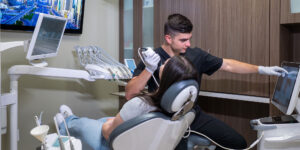
- A plain-language explanation of your options. We describe what a veneer, a crown, bonding, or another approach would involve for you, and why we do or do not recommend it.
- Attention to comfort. If dental visits make you anxious, we can talk about sedation dentistry.
Dr. David Shirinian, a USC School of Dentistry graduate and a member of the American Academy of Cosmetic Dentistry, leads our team. We offer both crowns and veneers at our Pasadena and Burbank offices.
Questions to ask when choosing between a crown and a veneer
A good consultation is a two-way conversation. Whether you ask us or any other provider, these questions can help you feel confident:
- How much natural tooth will be adjusted? Ask what needs to be removed and what that means for the long term.
- How will the result match my smile? Color, shape, and proportion should suit your face and neighboring teeth.
- How will I care for it? Ask about daily care, checkups, and whether habits such as teeth grinding could affect the restoration.
- What are the alternatives? A thoughtful provider should explain why one option is recommended over another, including bonding.
- What will it cost, and what help is available? Our team can explain insurance coverage and financing options so there are no surprises.
It is also reasonable to see how a practice is regarded by other patients. You can find Signature Smiles Dental Group on Google Maps, Apple Maps, and Yelp, and read patient reviews on Yelp and our Google Business Profile before you book.
Frequently asked questions
What is the main difference between dental crowns and veneers?
A veneer is a thin, custom-made covering placed over the front surface of a tooth, usually chosen for cosmetic goals such as shape or color. A crown covers the tooth more fully and is commonly considered when a tooth is weakened, heavily restored, or has had a root canal. Veneers typically involve removing less tooth structure than crowns, and your dentist can tell you which fits a given tooth after an exam.
Can I get crowns or veneers near Pasadena without traveling far?
Yes. Our Pasadena office on East Colorado Boulevard offers both, and we also have an office on Glenoaks Boulevard in Burbank, where patients from Magnolia Park and Toluca Lake often visit. Our sister office in Glendale is another option for neighbors in that area, so ask which location suits you best. You can find us on Google Maps, Apple Maps, and Yelp, where you can also read patient reviews.
How do I know whether I need a crown, a veneer, or bonding?
It depends on the condition of your teeth, what you hope to change, and your dentist's recommendations. Bonding shapes material directly onto the tooth, veneers are custom-made coverings for the front surface, and crowns cover more of the tooth. An examination is the most reliable way to decide.
Next steps with our Pasadena team
If you would like to compare crowns and veneers for your own teeth, the simplest step is a conversation. You can schedule a consultation at our Pasadena office, or ask about our Burbank location if that is closer to home or work. If you are not ready to book, contact us with your questions, and we will listen to your goals, explain your choices clearly, and help you decide what is right for your smile.